Monday, October 4, 2021

Minor League Football

 James and I agree that there ought to be a minor league football system, like AAA baseball or the AHL. He is fascinated by the system of farm teams that the Amerks and the Red Wings are a part of and has asked for the names of each team in those leagues. We decided that we would both take our best shot at what we thought an NFL minor league ought to look like, and this was what we (separately) came up with:

Dad's Minor League Football

Toronto Moose (BUF)

Puerto Rico Swordfish (MIA)

Newark Pilots (NYJ)

Providence Minutemen (NE)

Dover Hawks (BAL)

Morgantown Smelters (PIT)

Columbus Dogs (CLE)

Louisville Lions (CIN)

Memphis Olympians (TEN)

St. Louis Stallions (IND)

Charleston Cheetahs (JAX)

Austin Longhorns (HOU)

Salt Lake City Pirates (LVR)

San Diego Volts (LAC)

Colorado Springs Buckaroos (DEN)

Oklahoma City Braves (KC)


San Antonio Stars (DAL)

Scranton Kestrels (PHI)

Virginia Beach Football Team (WAS)

Long Island Heroes (NYG)

Omaha Blizzard (MIN)

Grand Rapids Cougars (DET)

Des Moines Grizzlies (CHI)

Milwaukee Cheese (GB)

Orlando Privateers (TB)

Birmingham Generals (ATL)

Raleigh Bobcats (CAR)

Biloxi Hurricanes (NO)

San Jose Pioneers (SF)

Portland Storm (SEA)

Santa Barbara Sharks (LAR)

Albuquerque Scorpions (ARZ)


JAMES' LEAGUE

Washington Wings (BAL) (Owen's suggestion)

Dover Stars (PIT) Also Owen's suggestion, James wanted the "Materials"

Columbus Blacks (CLE)

Cleveland Siberians (CIN) Siberian Tigers--they would have the Bengals' helmet, but all white

Baltimore Horseshoes (IND)

Austin Bulls (HOU)

Tallahassee Sickles (TEN) Named after the sickle that the Titan Cronos used against Ouranos

Atlanta Speeders (JAX)

Rochester Bisons (BUF)

Boston Cheetahs (NE) "Cheet-ahs." Get it?

New Jersey Missiles (NYJ)

Birmingham Sharks (MIA)

Topeka Arrows (KC)

Oakland Armor (LVR)

San Diego Bolts (LAC)

Colorado Springs Horses (DEN)


Milwaukee Cheese (GB)

Chicago Kings (DET)

St. Paul Purple Team (MIN) James named this in honor of Abby, because she couldn't remember the Viking's name once and kept calling them the purple team

Springfield Grizzlies (CHI)

Orlando Pirates (TB)

Baton Rouge Bananas (NO) Because, as Felix points, the Saint's logo looks like a banana peel

Illinois Big Cats (CAR) Owen's suggestion

Raleigh Devils (ATL)

Harrisburg Flys (PHI) James insists on the spelling. Not the bug flies, but "fly"

Baltimore Football Team (WAS)

Houston Cowgirls (DAL)

New Jersey Stink Bugs (NYG)

Salt Lake City Sheep (LAR)

Sacramento Silver (SF)

Phoenix Reds (ARZ)

Olympia Sea Gulls (SEA)

Saturday, October 2, 2021

September Pictures


James was motion-sick, but it was an otherwise lovely boat ride

Owen's friend Lydia

Waiting his turn in the sidewalk scootering heats

Somehow (per usual) Owen is on Felix's scooter

We are back to school! James is a 5th grader now...

Owen working on some math

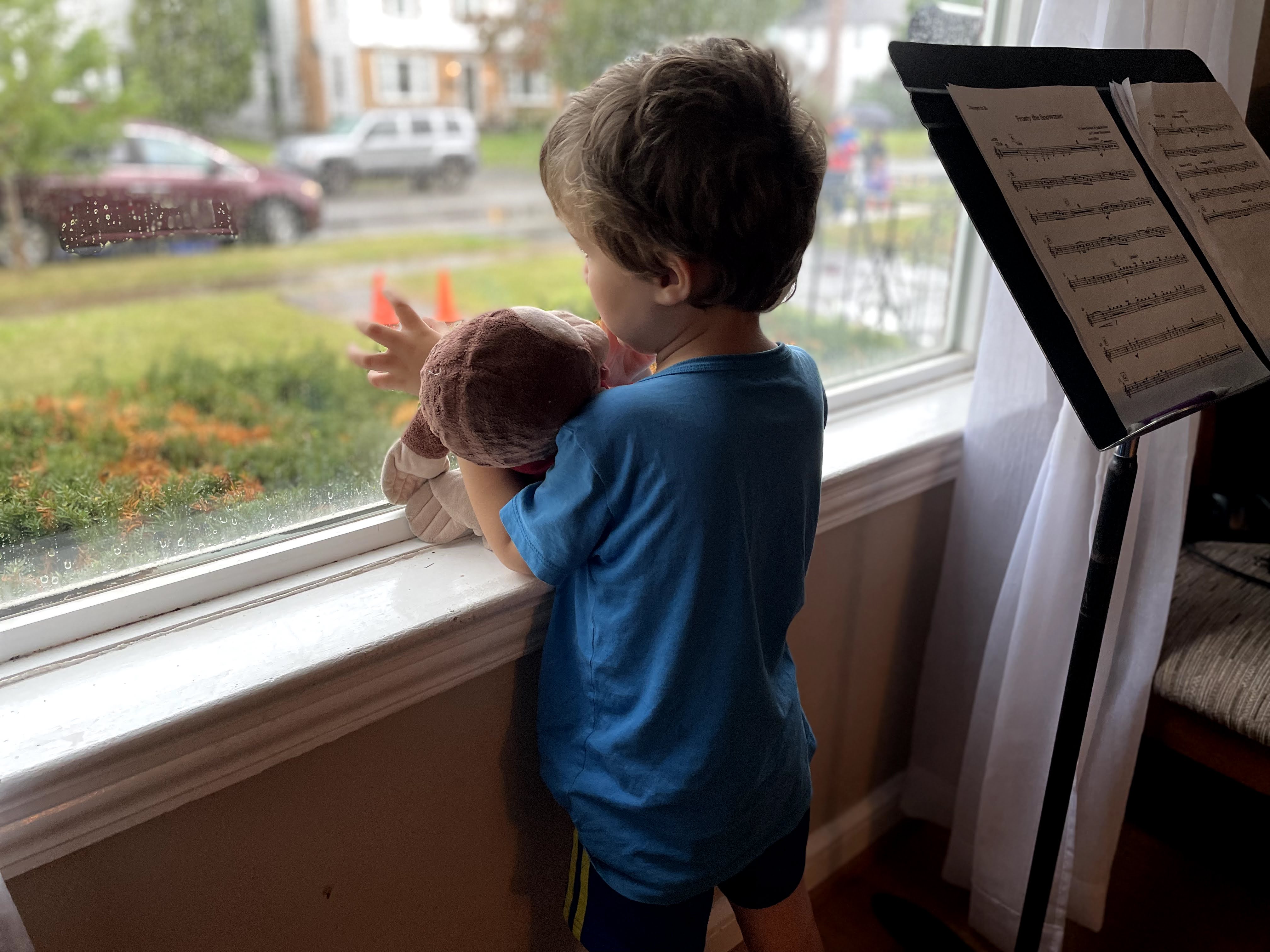
Felix watching the public school kids head in on a rainy morning. It's rough for him to not have any school to do while James and Owen are occupied.

L

Last Netsin's trip of the summer

A visit to the art gallery

Owen was on a scavenger hunt

Someone found "F-E-L-I-X"

James relaxing in the sculpture garden

"Please do not climb on the sculptures"

He is a handsome chap in those glasses. We currently have no idea where they are.

"Hey Dad? Excuse me? I have a question..."

Backyard games


Felix has a hard time sitting still at church these days. I sometimes let him play with my phone to keep him occupied, and here is one of several dozen selfies that he took...

Outdoor reading while it's still kind of warm...

"Look, Dad! We are all Julius Caesar wearing laurel crowns!"

Saturday, September 18, 2021

Recitals and Espresso

 This week we marked two events that were a long time in coming. The first was a live movie music recital, and the second was the brewing of our own espresso.

The recital was booked back in June, and I went back and forth wondering whether the hall would be packed or whether we would be playing to an audience of maybe ten people. It turned out that the hall was packed.

I also went back and forth wondering whether we were doing something that was incredibly self-indulgent and narcissistic (Here, everyone! Come listen to us play a bunch of music that we like) or incredibly generous. (We will pay to hire any accompanist and won't charge admission to this concert so that we can share music that you all apparently liked during the pandemic)

The lead-up to the recital was very different than any of our school recitals. Back when we were students we didn't have to change any diapers before the recital or teach James about the Assyrians. For me, playing a solo recital is a very different animal than playing an orchestra concert. Orchestra concerts happen every weekend, and in any given show there might be 45 seconds of total music when I'm playing something that is alone/exposed. At really big shows (playing principal on the Messiah with Trumpet Shall Sound) I might be exposed for a whole three minutes. A recital is an hour of exposure.

But this one was different...there was a sense throughout the whole process that it was just going to be fun and that we wouldn't take it too seriously because it was more about J and I getting to do something together than it was about the quality of the trumpet/flute playing. (Which was still, I think, pretty good)

We got to the hall about an hour early (after noticing that the van didn't start very easily) and asked the kids not to run laps in the empty performance hall. So we warmed up while the kids ran laps in the empty performance hall. A few people poked their heads in, and then Nama/Papa/Aunt Martha arrived to take the boys off of our hands.

It ended up being a packed hall. And it was a great audience. When you are performing you can sometimes tell if the audience is bored/losing focus, and it felt like ours was hanging with us through each tune. On the program were Princess Leia's Theme (because it was the original arrangement in the project, and is still one of the most equal duets in our folder), Wall Rat (because it is such a good flute showcase, and also because Paris), Little Women (because the film is so meaningful and beloved to J, and also because it shows off piccolo trumpet. We also found out once we started rehearsing that it was a childhood favorite of our pianist), and then the Escapades Suite, of which we'd recorded the first movement but none of the others. That suite was the most complete "concert piece" on the program, and we build everything else around that. We took a brief intermission, then did Far and Away (because it was far and away the most popular video that we posted), an arrangement of the Easter Hymn with For the Beauty of the Earth based on J.F.K. (because we thought that we should do some sacred music at Roberts), a suite from Harry Potter (Sirius' Escape, Family Portrait, Hagrid's Friendly Bird, and Quidditch), and then Married Life from Up! to close. (Because this recital was really as much about J and I getting to do something together as it was about flute and trumpet.

And then, when we had finally said goodbye to everyone, taken all the photos, and loaded up the van...it wouldn't start.

So we unloaded the van, called around to any friends in the area who we thought might still be conscious, called the insurance roadside assistance line, and tried to make the best of the situation. At some point (culprit and time still unknown) someone threw up on Felix's carseat, and it reeked the entire way back to our house, stinking up our friend Joy's van. I got a jump from roadside assistance, and was home by about 11. It was not the most elegant end to the evening.

Speaking of things that we've dabbled in but have never fully committed to until now and are henceforth likely to have in our life on a very regular basis, we are brewing our own espresso. This has been in the pipeline since Paris, although we did mess around with a beginner level machine that Oliver and Kylie gave us for a while (getting some decent results) and a moka pot on the stove. (Getting less than decent results.)

We ordered a proper grinder a few months ago, but it was an international order and didn't ship until just last week. With the grinder on the way we ordered the actual machine we'd been waiting on, and it beat the grinder by a week. We didn't want to wait, so we've been pulling shots of my homeroasted Yirgacheffe the last few days with our entry level conical grinder. It's way too much fun. And it's way too expensive of a hobby to get fully immersed in. But if you happen to be stopping by anyway, let us make you a cup of espresso sometime soon...we're getting better with each shot.

Saturday, September 11, 2021

Mom is En Vacances

 I took the kids to the Memorial Art Gallery this week.

Owen was disappointed, because he thought it would be mostly suits of armor and swords and it turned out that it was just a bunch of pictures and stuff. That's boring.

James was disappointed because the other two ran out of gas before he could find all of the portraits in his scavenger hunt.

Felix thought that the mummy was scary. Everyone thought that tribal bird mask in the Folk Art collection was scary. 

Felix inherited his mother's response to art galleries. Interest and curiosity for ten minutes and then a sudden overwhelming need to lie down in a public place. (Felix's mother usually suppresses this reaction in herself until she gets back to her own vehicle. Felix, not so much)

"What's the number rule of being in the art gallery?" James: "DON'T. TOUCH. THE PAINTINGS." (Felix did not learn the number one rule.)

Owen has started prefacing things with sentences like: "I don't mean to hurt your feelings, but..." or "I'm not trying to be mean to you, but..." And then, no matter how many times you attempt him to stop whatever he is about to say from coming out (once he starts one of these sentences, he must complete it, even if you are actively carrying him away from his victim) he goes on to say something like "I noticed that your bathtub is a really weird shape." "I remember that the last time we visited your house you had popsicles and I'm wondering if you have any more of them." "I noticed that you have a seashell collection and I really like seashells and I think you should give me some." "I went into the bathroom after you were in there and it smelled really bad." "I think that you aren't very good at cooking hamburgers and I could cook them better than you."

The good news is that he can tell that he's about to say something rude. The bad news is that he apparently has no compulsion about saying it anyway.

More questions from Owen:

"Do worms have eyes?"

"Do bacteria have eyes?"

"How do worms know which direction they are going?"

"I don't want you to die because you are old. Is there a way that if I died, you wouldn't have to die?" 

Overheard James to Owen: "Leave that cocoon to its own business."

Felix has been struggling. Four was hard for each of the kids, and so far Felix is taking it all out with his fists. He's suddenly punching us when he gets angry. He clearly isn't putting his heart into it, just trying to provoke a reaction out of whoever is forcing him to do something against his will. (Usually making him sit on the potty.) So you can tell him that this isn't a very good way to express the feelings that he's feeling, and that it would be better if--WHUMP!

Also, he's learned how to kick you in the balls. Hard.

Wednesday, September 1, 2021

Several Updates

 The boys have started school again, and James, who appeared to register no reaction to the news that he would be repeating Saxon 5/4 Math when I informed him of the fact back in July, is now embarrassed that he is doing last year's math (and grammar) over again. With that said, he's flying through the "easy" material at the beginning of the book and hopefully working up some good momentum for the sections with fractions, long division, and exponents.

Owen has been less truculent so far, although you never know when he's going to suddenly square down and refuse to do something reasonable (like put periods at the end of his sentences) for several hours because of something unreasonable and unrelated, like having the wrong color roof on our house or not being able to own his very own podracer from Star Wars.

Felix is also having a decent start to the school year. He reads Bob books or "Baby Monkey, Private Eye," or goes upstairs and gets into all of the toys that Owen would usually shout at him about when they are up in their room together. He's been getting better about keeping his glasses on, which at first could only be accomplished by letting him watch a movie or wear his oversized Bills jersey.

I am sifting through the schedules of 7.5 hours of students and trying to find a way to make them line up in a way that lets me take care of all of my teaching in one day, gets me to the right campus at the right time with an appropriate amount of travel time, and maybe even lets me eat a meal or two along the way.

We are rehearsing with our pianist for the movie music recital tonight and looking forward to working with a live human being instead of the Finale playback, which is prone to jerking into inappropriate tempos and either disappearing into inaudible softness (during piano dynamic playback) or nearly blowing out the cheap laptop speakers we have hooked up to the computer during loud playback. An additional frustration with the computer playback is that if you unplug the speakers or the computer Finale will crash, and that none of your other computer functions can make noise while Finale is controlling the sound. Finale is kind of the worst.

Kindle books always come in multiple groups. After remarking to J several times over the course of August that I didn't have anything new to read and that all of my holds were taking forever to come in, I all of a sudden have The Bomber Mafia, The Four Winds, The Daughters of Sparta, Homer's Daughter, Six Frigates, Next, and the newest Andy Weir novel.

I was sitting outside yesterday afternoon, reading in one of the lounge chairs with a glass of wine while the boys biked back and forth on the sidewalk. After fixing a leaking hose (because of course something would break) I had to go back inside...for a sweater. I think that fall is around the corner...

Monday, August 16, 2021

GPC Sermon 8/15


“Be careful then how you live, not as unwise people but as wise, making the most of the time, because the days are evil. So do not be foolish, but understand what the will of the Lord is. Do not get drunk with wine, for that is debauchery; but be filled with the Spirit as you sing psalms and hymns and spiritual songs among yourselves, singing and making melody to the Lord in your hearts, giving thanks to God the Father at all times and for everything in the name of our Lord Jesus Christ.”


Don’t get drunk, but spend your time singing. You should all join choir. Paul’s command in this morning’s epistle seems straightforward, and if we were to walk away having only heard that attending a hymn sing is better than getting smashed at a bar, that would be fine advice.

I’d like to dig deeper into what exactly Paul means when he commands us to sing. We’ll need to think about what singing was in Paul’s culture and what singing is in our own time. What assumptions do we bring to this passage? If we name those assumptions for what they are, how do they color our understanding of Paul’s call to sing? This is a task he gives throughout his letters, and one that we have to assume is intended for us as well. Why singing?

Let’s think about what singing is in the modern world. Among many other things it is a form of self-expression, a way of transmitting culture across the globe, a spectacular money-maker for the popular recording and performing industries, a less than spectacular money-maker for opera companies, a way to reach emotional catharsis, a binding agent for sub-cultures (country, punk rock, Swedish folk music) to make their identities and define themselves. Above all singing in the modern world is two things—it is intensely individual, and it is one of our leisure arts.

For most us the prospect of singing in public (especially alone) is terrifying. It’s literally the stuff of nightmares. Singing is something you might do in the shower (where you get some nice reverb off your bathroom tiles) or alone in the car when you don’t think anyone is watching, but you wouldn’t dream of volunteering to sing in a waiting room or a restaurant, unless you had been born with unusual natural gifts (the sort that shows like the Voice and American Idol are always digging around to find) or had spent many years practicing and refining. And even if you were a naturally gifted or a highly trained singer, you still wouldn’t sing in a waiting room, right? Because singing, as a leisure activity, is restricted to certain appropriate times and situations. A child’s birthday party, a church service, a musical recital, or a karaoke bar while heavily intoxicated are among the few domains left where singing is expected and allowed. (I make no judgement on whether this is a good or a bad thing.) Singing, like chess-playing, archery, and horseback riding, is a hobby. It’s for private people (only a small set of the general population) and for very specific settings. But singing in Paul’s world didn’t work that way.

Before we get into what singing was in the ancient world, I’d like to point out one quick aspect of the singing voice that normally escapes us in modern churches. A sung (or chanted) word carries further and clearer than a spoken word. We haven’t had to think about this since the arrival of modern sound systems (thanks to our sound team for the excellent job they do), but there was a reason why medieval church services, in those massive unelectrified cathedrals were all chanted. You can hear the proclamation of the word much more clearly when that proclamation is sung instead of spoken.

If singing in the modern world is private and a leisure activity, singing in the ancient world (both Jewish, as in St. Paul’s context, and Greek, where he was doing his ministry) was very much a public activity and one of such high importance that it could be called an essential service. To put this in perspective I’d like to look at a man who actually gave a critique of music in the ancient world—a man condemned to an unjust death by the state after raising the ire of the religious leaders of his city, and who went to his execution willingly in order to uphold the principles that he lived by throughout his controversial public career, and who was widely commemorated and imitated by his disciples after his death despite leaving no primary texts of his own. And no, it isn’t Jesus of Nazareth.

The Athenian philosopher Socrates died in 399 BC, and what he said against singing and music throws the assumptions that St. Paul was making about its importance into sharp relief. Socrates was accused and condemned on two charges—asebia, or impiety against the gods of Athens, and corruption of the youth of the city. These charges (and the narrow margin of conviction) remain difficult to understand to this day despite thorough documentation by Plato and Xenophon of all of the events leading up to the trial, the trial itself (full of long speeches), and the events of Socrates’ final days up to his death by drinking a cup of hemlock.

The manuscripts of the Socratic dialogs (especially the Republic) plainly show a philosopher who takes the existence of the Greek gods for granted and treats them with great reverence. He was well-regarded by the youth of the city, and his teaching practices were not any different than the other notable philosophers of the day. Socrates was unusual in his teaching only in that he refused to take payment, which certainly isn’t a crime worthy of a death sentence. Socrates died because he attacked Greek music.

Singing in the ancient world meant a number of things that it no longer means to us. First and foremost, it was a form of memory. The setting of text to song and melody makes the task of passing it on immensely easier. Not many (or any of us) can remember the geometry formulas that we spent hours trying to memorize in high school (except maybe those that use math in their careers now), but how many of you can instantly recall the soap, toothpaste, and gum jingles you heard on TV in your youth and never made any effort whatsoever to commit to memory? In a pre-alphabetic society, a culture must pass itself on to generation to generation through strength of memory alone, and the best aid for this is song—the type of song that we now call epic poetry.

Before the Greeks inherited an alphabet from the Phoenicians, they had already established a national identity, one that was rooted in several enormous poems about the wrath of Achilles, the homecoming of Odysseus, and the story of the gods. The Iliad, the Odyssey, and to a lesser extent, the works of Hesiod.

To be Greek was to know these poems, and these poems were sung—sung in an easy-to-internalize dactylic hexameter so that each generation could hear these poems every year at the great Greek festivals and memorize thousands of lines of poetry, thereby becoming true Greeks and sharing in the common culture. But these poems were more than just “books that everyone liked.” Even comparing them to the significance of the Bible for medieval Christians falls short, because not only were the stories (which are wonderful stories, and remain interesting to this day) culturally important, but the poems themselves were the society. The Iliad and the Odyssey were a tribal encyclopedia.

Listen to a passage for illustration. Calypso is helping Odysseus build a raft to escape from her island. The story of the Odyssey is advancing in this passage, but listen to how it is also a piece of education—you’re going to learn how to build a raft. “She gave to him a great axe, well-fit to his hands, sharpened on both sides. And in it was a beautiful handle of olive wood, securely fastened; and thereafter she gave him a polished cutting tool. Then she led the way to the borders of the island, where tall trees were standing, alder, poplar, and sky-reaching fir, long-dry and well-seasoned, which would float lightly for him…he fell to cutting timbers, and his work went on apace. Twenty trees in all did he fell, and trimmed them with his axe, and then he cunningly smoothed them all and made them straight to the line.”

The passage goes on to describe how he bores the trees out and fits them with pegs and mortices. It’s the sort of knowledge that we could find in a Youtube video or in a library book. For a Greek child in the days before widespread alphabetic writing, memorizing this part of the story (with its rhythm just as catchy as the Kit-Kat jingle) is his education—his paidea—in how this process works.

Other passages show the proper prayers before a funeral sacrifice, the respectful ways in which an unmarried young woman should address a stranger, how to properly plead your legal case to the ruler of a citadel, how to beach a ship in a semi-open harbor or to avoid a reef in a headwind, or even how to flay, season, and roast a sheep. The Iliad and the Odyssey are the stories of the death of Hector and the homecoming of Odysseus, but they are also the Bible, hymnal, Encyclopedia Britannica, and Youtube of Greek society. They would have always been sung, and they would have always been regarded as an essential column of the Greek paideia—the education. In fact, the way to cinch an argument in Greek society, even for Socrates, who was openly skeptical about the poets, was always to quote the appropriate verse from Homer.

So let’s return to Socrates, who in the Republic is asking “What is the ideal paideia/education for the ideal citizen in the ideal state?” and three times makes progressively more vicious attacks against the Greek poets and the tradition of Greek singing. Socrates was put to death because at the end of the Republic he displaces that tradition. He declares that “philosophy is the supreme music” and banishes the poets (Homer) and the singers from his ideal city entirely. We don’t need to dig into why he comes to this conclusion (broadly, that philosophy is a better way to do paideia than the Greek poets), but once we acknowledge how central to ancient culture the practice of “singing psalms, hymns, and spiritual songs” is we can understand what it is that St. Paul is summoning us to do.

Let’s think about the epistle reading again. St. Paul is not instructing the Ephesians to engage in some private hobby that he happens to like particularly (as if he wanted the whole church to take up stamp collecting because he thought it would be a good way to keep them out of the bars on Wednesday evenings), but to engage in corporate singing because it is the process by which a community in the ancient world clarifies itself, passes on its learning from one generation to the next, internalizes an enormous length of text, and describes the world in which it lives over and against the competing narratives of outside cultures. He is not asking for a private leisure activity—he’s calling for a public essential service.

Throughout the New Testament, including Revelation, the minor epistles, and the gospels, there are endless passages that demand to be sung, and to be sung corporately. Take the book of Ephesians itself. It was a piece of mail, from the apostle Paul to a local house church. But it was a piece of mail that was clearly meant to be proclaimed out loud with the community standing around and physically present, and at least at the end of chapter 3, the quotation of a Psalm in chapter 4, and the quotation about Sleepers Awaking in chapter 5 (Paul several times quotes pagan poets in his speeches and letters) the gathered community could have and would have broken into song together. Perhaps the clearest example of this is the Christ hymn in Colossians. Imagine that you are sitting in a house church listening to the letter being read aloud. Immediately after Paul makes his trademark overlong greeting and opening prayer for the Colossians, the whole community would have burst into a hymn about Christ <sing> the image of the invisible God, the firstborn of all creation; 16 for in[h] him all things in heaven and on earth were created, things visible and invisible, whether thrones or dominions or rulers or powers—all things have been created through him and for him. 

None of us have any idea what the melody or rhythm ought to have been, but again and again we find in Paul a community gathering around and doing something more than just singing by singing together.

My favorite explanation and analogy for this comes from Tom Wright, who compares corporate worship to an angled mirror. That mirror reflects the glory of the Creator god out into his creation, and it also reflects the praises of that creation back up to God. We, as the church, are the halfway people where heaven and earth are united—this being the promise of new creation inaugurated in Jesus’ resurrection. We sum up the praises of earth and sing them to our God, and we sing out the story of our God’s saving actions to the earth he plans to heal and redeem.

There are two more features of this process worth pointing out. First, much like the performing of the Odyssey and the Iliad, this type of singing is deeply mimetic. Mimesis (meaning imitation, from which we derive mimicry) is the process of emotional and spiritual imitation by participation in what is being enacted. This was why the Greeks loved their (sung) dramas so much. The audience would participate in the story mimetically—the tragic scenes feel heartrending, the battle scenes make your blood boil, and the comedies double you over in laughter. To participate in Christian corporate singing, whether we tremble with the awful majesty of an organ hymn commanding our praise to the Most High, or plaintively lament the sorrows of a broken world, or get sent forth in joy and cheerful mission, we participate mimetically by perceiving and taking a share in the God’s story for the world.

Secondly, corporate singing is uniquely suited to performative utterance. The classic example of performative utterance in individual speech is a minister saying aloud “I pronounce you man and wife.” That sentence, just as a statement, can be diagrammed and analyzed traditionally with the subject and verb and objects and whatnot. But the sentence is more than just an indicative statement. The act of saying the words aloud imbues them with special meaning on top of the literal meaning of the sentence—there is a legal and spiritual reality to the words that necessitates them being publicly spoken and heard in that moment. You can’t have the best man say those words, and they don’t count in the same way at the wedding rehearsal as they do on the day of the wedding.

That same kind of public necessity runs through our hymnal. The angled mirror demands that we lift our voices together, and when we sing “on earth as it is in heaven,” “to God by the glory,” “forgive us our sins,” and “all glory, laud, and honor to you redeemer King,” we participate in those truths becoming reality in the same way that a minister “makes” the couple become “man and wife.” Just this morning when we sang the opening hymn we publicly declared that God made the mountains rise, spread the flowing seas abroad, and ordained the sun to rule the day. In a moment we will summon all creatures of our God and King to lift their voices, calling even the sun and the moon themselves to sing praises. We do that with the authority to say, “I pronounce you man and wife.”

To sum up, why does Paul command us to be filled with song instead of filled with drink? Not as a private hobby, but as an essential mark of our community, and intrinsic to our life-changing and world-renewing vocation. Corporate Christian singing is our cultural memory, our tribal encyclopedia. It is what binds us together, and it is the angled mirror by which we reflect both the good creation and our living God, repeating his story into the world with mimetic fervor, making performative utterances, and living in obedience to our call to sing. May God bless the singing of his word.

Sunday, August 1, 2021

Questions from Owen

 Owen is full of questions. They all begin like this:

"Excuse me, Mommy?"

"Yes, Owen?"

"I have a question."

"Owen, you don't have to say excuse me and that you have a question separately each time. It's really fine if you just ask the question."

But he always excuses himself first, and then makes an announcement that he has a question. Every time. All day long. Every day. We started keeping a list, so here is a partial sampling. Just keep in mind that you have to imagine the full preface before each one. 

-Are tadpoles slimy?

-What's your least favorite hockey team?

-Do bulldozers have brains?

-What's the best way to start reading? (This was a joke. The answer is, "the letter R")

-Does it help if the kids stay awake when you have to drive all night through the night?

-Does Mom snore?

-Why does Daddy always drink beer? (I've had exactly one beer in 2021)

(upon being X-rayed at the dentist's office)--Can I keep the picture?

-Would you rather be Darth Vader or Mace Windu?

-Are babies poisonous to dragons?

-What are you going to do with the car when you buy a new one? Can I have it?

-Can glasses get chicken pox?

-Are cars faster than clouds?

-How easy to destroy are TIE fighters?

-Would you rather spend a few bucks on a pizza or wash dishes all afternoon?

-This isn't actually a question, I just want to tell you that chapel is a little bit boring, plus even a little bit more boring.

-Which has more sugar, apple juice or gatorade?

-Is philosophy the study of ancient statues?

-Why aren't there any roads named after me?

-True or false, can hamburgers move on their own?

-Can James smell with his tongue?

-Why can't a six year old be a Roman emperor?

-Do birds have birthdays?

-Why can't you get rid of ticks by shooting them into outer space with a bow and arrow?

-If you dropped a leaf twenty miles up in the sky above the entrance of a park and then a hiker went from one end of the park to another would the hiker get back first or would the leaf touch the ground first?

-Do you need my calculator to figure that question out?